The Disney World Transportation Guide I Wish Someone Had Given Me
Disney World transportation is free, extensive, and surprisingly complicated. Buses, monorails, the Skyliner, boats and walking paths connect most of Walt Disney World, while cars and rideshare provide paid alternatives. The best option, however, depends on where you’re staying, where you’re going, and how much time you have.
This guide explains how every transportation system works, where each one goes, how long you should actually budget, and when paying for a rideshare can be worth it.
That gap between what people plan for and what actually eats their day is why I wanted to write a proper Disney World transportation guide. Not a list of what exists, because Disney’s own site will tell you that. What I want to give you is the part nobody says out loud: which systems are actually good, which ones quietly cost you an hour, and how the choice you make when you book a hotel locks in your daily commute for the entire trip.
Table of Contents
How Disney World transportation actually works
Walt Disney World is enormous, and there isn’t one transportation system that connects everything directly. Instead, Disney operates several different systems that work together: buses, the monorail, the Disney Skyliner, boats, and walking paths. Guests can also choose paid options such as driving, rideshare, or Minnie Van.
Most Disney-operated transportation is complimentary. The challenge isn’t figuring out whether transportation exists, it is figuring out which option makes the most sense for the trip you’re trying to make.
Complimentary Disney Transportation
Disney buses are the backbone of the transportation system. They serve all four theme parks, Disney Springs, and the Disney Resort hotels, making them the most universally useful option. If there isn’t a convenient walking, monorail, Skyliner, or boat connection, there is a good chance you’ll be taking a bus.
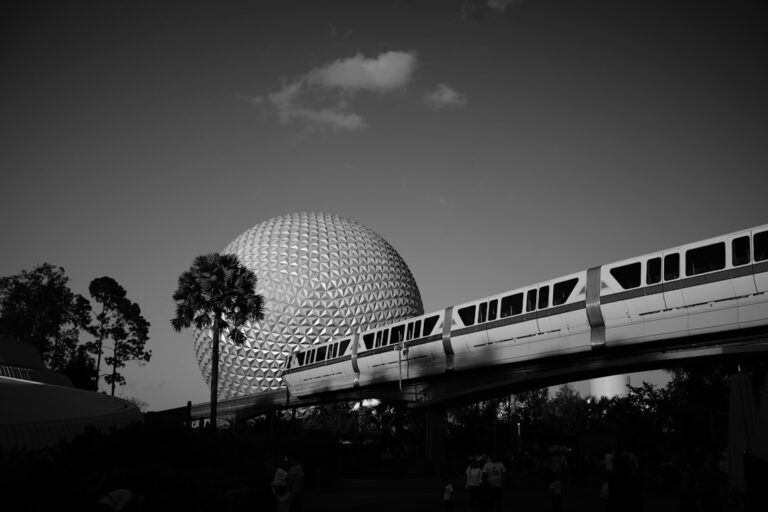
The monorail serves Magic Kingdom, EPCOT, and three resorts in the Magic Kingdom area: Disney’s Contemporary Resort, Disney’s Polynesian Village Resort, and Disney’s Grand Floridian Resort & Spa. It is particularly useful for guests staying in the Magic Kingdom resort area.
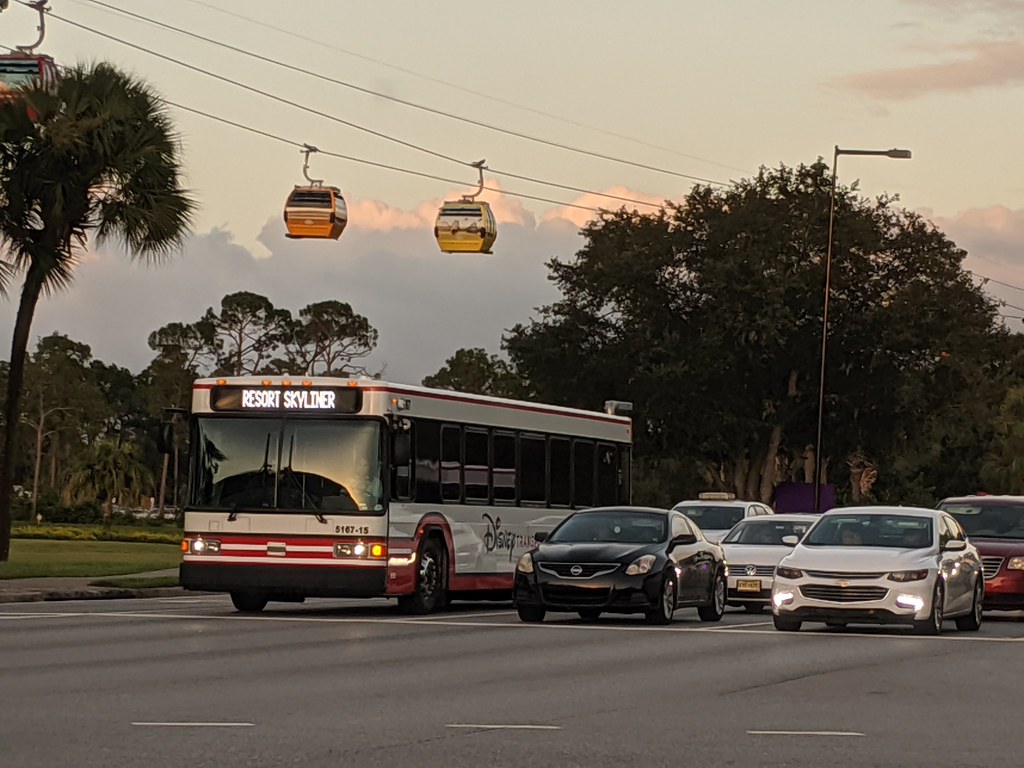
The Disney Skyliner connects EPCOT and Disney’s Hollywood Studios with several resorts in the EPCOT and Hollywood Studios area. It is one of the most useful transportation options for guests staying at a Skyliner-connected resort.
Disney boats provide several different routes between theme parks, resorts, and Disney Springs. They are generally slower than traveling by vehicle, but they can be an enjoyable and sometimes surprisingly convenient way to move around Walt Disney World.
Walking is easy to overlook, but it can be the fastest transportation option on certain routes. Several resorts are within walking distance of a theme park, and some park-to-park routes can be walked as well.
Paid Transportation
You can also use your own vehicle, a rental car, Uber or Lyft, or Disney’s Minnie Van service.
Paid transportation isn’t automatically better than Disney’s complimentary transportation. It becomes most useful when time, convenience, or a specific destination is more important than cost.
For example, spending money on a rideshare to travel between two Disney Resort hotels can make considerably more sense than taking a bus to a theme park and transferring to another resort bus.
The Most Important Thing to Understand
There is no single Disney transportation system that is best for every situation.
The best option depends on:
- Where you’re starting
- Where you’re going
- What time you’re traveling
- How much time you have
- Whether you have a reservation or other fixed commitment
- Whether you’re willing to pay for convenience
This is why transportation should be considered when planning your Disney World day, not treated as an afterthought once you’ve decided where you’re going.
And where you stay matters enormously.
Some resorts offer walking access to a theme park. Some have direct Skyliner access. Some connect to the monorail or boats. Others rely primarily on buses.
If you’re choosing a Disney Resort, transportation should be one of the factors you consider, not simply a way to get around after you’ve made your choice.
For a resort-by-resort breakdown of exactly which transportation options are available, see our Disney World Transportation by Resort guide.
Getting Around Disney World Without a Car
You do not need a car at Disney World. That is the short answer, and for most people staying on property it is the right one. But “you don’t need a car” and “you won’t miss having one” are different claims, and the second one isn’t always true.
What works without a car: everything inside the bubble. Park to park, resort to park, resort to Disney Springs. Every complimentary system is free to everyone, resort guest or not, and between buses, the Skyliner, the monorail, boats, and walking paths there is a route from anywhere on property to anywhere else on property.
What costs you: time, and specifically time at the worst moments. Park closing is when the system is most stressed and you are most tired. Cross-property trips that Disney has no reason to serve directly, like Animal Kingdom Lodge to the BoardWalk for a dinner reservation, can eat 45 minutes in transfers. Early morning departures for a rope drop at a park your resort serves poorly are the other pressure point.
The middle path most people miss is that going carless does not mean going car-free. Budget two or three rideshares across a week for the specific trips where Disney transportation is weakest, and you get the economics of no rental car with none of the worst days. An on-property Lyft runs roughly $15 to $20. Against a rental plus parking, you can take a lot of those before the math turns.
Where a car genuinely earns its place: off-site stays, Universal or other Orlando attractions, grocery runs, and parties large enough that every rideshare becomes an XL.
Which Transportation Should I Use?
| If you’re trying to… | Usually start with… |
|---|---|
| Get to Magic Kingdom from Contemporary | Walk |
| Get to EPCOT from a monorail resort | Monorail |
| Get to Hollywood Studios from a Skyliner resort | Skyliner |
| Get between EPCOT and Hollywood Studios | Walk or Skyliner |
| Get between Magic Kingdom and EPCOT | Monorail |
| Get from a resort to another resort | Rideshare or bus/transfer |
| Get to a resort dining reservation | Rideshare if time matters |
| Leave Magic Kingdom after fireworks | Whatever has the shortest current queue: ferry, monorail, or bus |
| Get to Animal Kingdom | Usually bus, car or rideshare |
| Get somewhere without a direct connection | Bus or rideshare |
There isn’t a single “best” Disney transportation system. The best option changes with the route and the situation.
Buses: the workhorse you will use more than you want to
Buses connect nearly everything to everything, but not quite, and the exception is the single most useful thing to understand about Disney transportation. Disney does not run redundant service. If your resort has a monorail, a Skyliner gondola, a boat, or a walking path to a given park, there is generally no bus to that park at all. Buses appear only as a backup when the primary system goes down.
In practice: the monorail resorts have no bus to Magic Kingdom or EPCOT. The Crescent Lake resorts have no bus to EPCOT or Hollywood Studios. The Skyliner resorts have no bus to EPCOT or Hollywood Studios. Every resort gets buses to Disney Springs, and every resort reaches the water parks by bus, though usually with a transfer along the way.
Buses are the backbone of Disney World transportation, and for many guests they will be the system they use most often. They’re also the least predictable option because your total trip includes the wait for a bus, loading, the ride itself and the walk to your destination.
Real numbers to plan around:
- Typical wait: 10 to 20 minutes at normal times
- Ride time: 15 to 25 minutes depending on the route
- Value and moderate resorts often have multiple stops within the resort, which adds time on both ends
- Park closing is the worst moment in the entire system. A full park emptying into a bus loop at once means you may watch one or two buses fill and leave without you
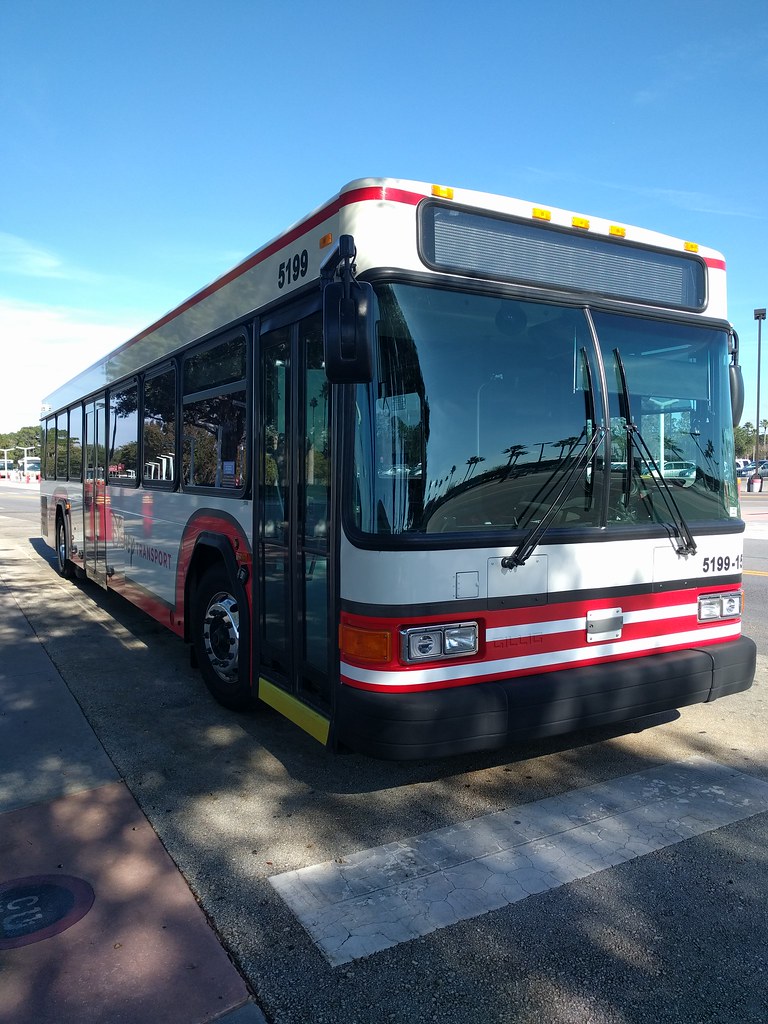
Additionally, some Disney buses stop at multiple resorts on their way back in the afternoon and evening. This has led to some issues personally in the past when we were staying at Bay Lake Tower and Disney’s Contemporary with a sick kiddo and our bus had to make a stop at Disney’s Wilderness Lodge This added about 10 minutes of travel time.
The Skyliner: the best thing Disney has built in years
The Disney Skyliner is the one piece of Disney World transportation that I actively look forward to using.
Instead of sitting in traffic or waiting for a bus, you climb into a gondola and glide above Walt Disney World. The ride itself becomes part of the experience, and on many routes the Skyliner is also an extremely practical way to get where you’re going.
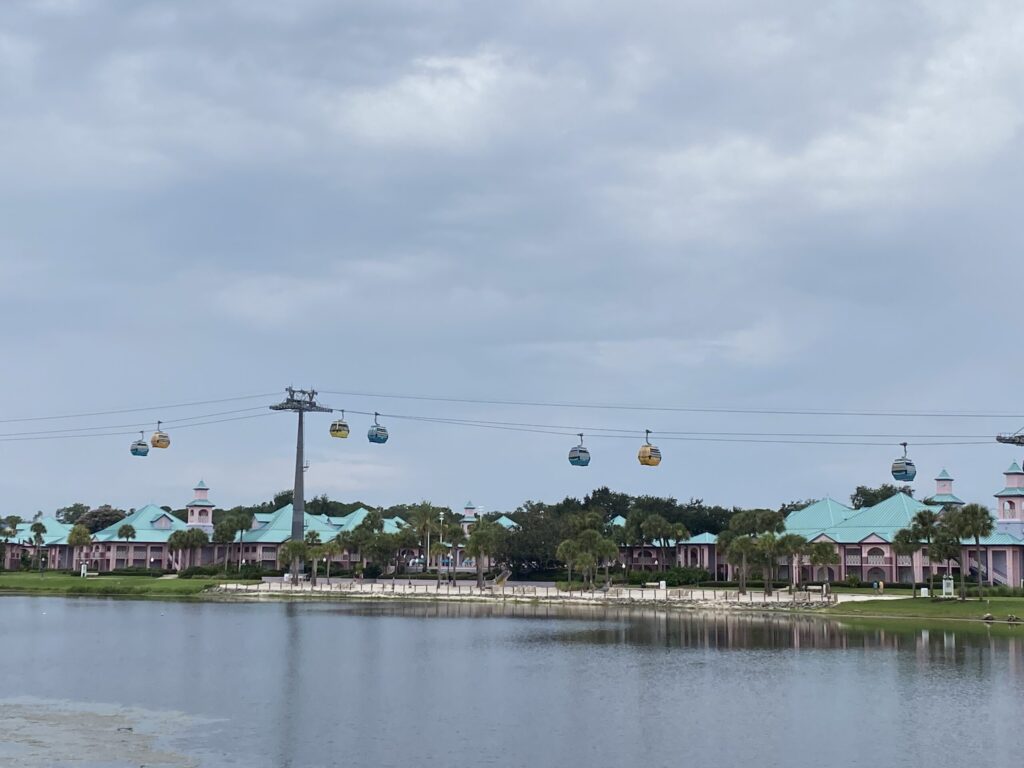
But its usefulness depends almost entirely on where you’re staying and where you’re going.
Where Does the Disney Skyliner Go?
The Skyliner connects EPCOT’s International Gateway and Disney’s Hollywood Studios with four Disney Resort hotels:
- Disney’s Art of Animation Resort
- Disney’s Caribbean Beach Resort
- Disney’s Pop Century Resort
- Disney’s Riviera Resort
Caribbean Beach serves as the system’s central transfer point. From there, one route continues to Hollywood Studios, while another connects to Riviera and EPCOT.
The EPCOT station is located at International Gateway, meaning the Skyliner enters EPCOT between the United Kingdom and France pavilions in World Showcase. The station is also within walking distance of Disney’s BoardWalk, Yacht Club, Beach Club and BoardWalk Inn.
The Skyliner does not go to Magic Kingdom or Animal Kingdom.
That limitation is important. The Skyliner can be an excellent transportation option for some Disney vacations, but it is not a replacement for the bus or monorail system.
Why I Like the Skyliner
The biggest advantage of the Skyliner is that the transportation itself is often part of the experience.
There is no road traffic, and gondolas continuously move through the stations rather than operating like a traditional bus route. Once you’re aboard, you get an elevated view of Walt Disney World that you simply don’t get from a bus.
The Skyliner is particularly useful for:
- EPCOT ↔ Hollywood Studios
- Pop Century/Art of Animation ↔ EPCOT
- Pop Century/Art of Animation ↔ Hollywood Studios
- Riviera Resort ↔ EPCOT
- Riviera Resort ↔ Hollywood Studios
- Caribbean Beach ↔ EPCOT or Hollywood Studios
The Skyliner can also make the resorts along its route substantially more convenient for park hopping and midday breaks.
The Transfer at Caribbean Beach
One thing that catches first-time Skyliner riders off guard is that Caribbean Beach is the transfer point between the two main routes.
If you’re traveling between EPCOT and Hollywood Studios, you may need to transfer at Caribbean Beach.
This isn’t necessarily a problem. The transfer is straightforward, and the gondolas keep moving. But it does mean that the Skyliner isn’t always a single uninterrupted ride between two destinations.
When planning a trip, think about the entire journey—not just the time the gondola spends in the air.
Weather Is the Skyliner’s Biggest Weakness
The Skyliner’s biggest disadvantage is also obvious: you’re traveling through the sky in a gondola.
Disney can temporarily suspend Skyliner service because of weather or other operational conditions. When that happens, buses can be used as an alternative.
This matters when you’re planning around a hard deadline.
If you have a 7:00 PM dining reservation, for example, I would not plan your entire transportation strategy around the assumption that the Skyliner will operate without interruption. Give yourself enough time for a backup plan when weather is questionable.
How Long Does the Skyliner Take?
The actual gondola ride can be relatively short, but the ride time is not your total transportation time.
You still need to account for:
- Walking from your room to the station
- Any wait or boarding time
- A transfer at Caribbean Beach when applicable
- Walking from the destination station to where you’re actually going
That’s an important distinction throughout Disney transportation planning.
A transportation system that has a 10-minute ride does not necessarily mean your door-to-door trip will take 10 minutes.
The Bottom Line on the Skyliner
If your Disney vacation involves EPCOT, Hollywood Studios, or one of the Skyliner-connected resorts, I would consider the Skyliner one of the most useful transportation options at Walt Disney World.
It’s not always the fastest option, and it’s certainly not available everywhere. But when the route lines up with your plans, the Skyliner combines convenience, relatively predictable travel, and an experience that is actually enjoyable.
And that is what makes it different from simply getting from Point A to Point B.
If you’re choosing a Disney Resort, don’t underestimate the value of having the Skyliner outside your front door. Transportation access can meaningfully change how easy it is to use EPCOT and Hollywood Studios throughout your vacation.
Disney currently lists Skyliner service as operating beginning one hour before Early Theme Park Entry begins at EPCOT or Hollywood Studios and generally continuing until 90 minutes after those parks close. Operating hours can change, so check Disney’s current schedule during your trip.
The monorail: iconic, convenient, and less reliable than it used to be

Three lines, and it is worth knowing which is which because people conflate them constantly.
- Resort Monorail: loops from the Transportation and Ticket Center (TTC) to the Polynesian, Grand Floridian, Magic Kingdom, and Contemporary, continuously around that loop
- Express Monorail: direct between the TTC and Magic Kingdom, no resort stops
- EPCOT Monorail: direct between the TTC and EPCOT
Hours: the Resort and Express lines start 30 minutes before Magic Kingdom opens and run until an hour after it closes. The EPCOT line starts 30 minutes before EPCOT opens and runs until two hours after it closes.
The monorail’s real superpower is Magic Kingdom to EPCOT park hopping. Take the Express to the TTC (or the Resort since there is only 1 stop at the Contemporary before arriving at TTC), walk across, take the EPCOT line. It is the fastest hop on property and it is the reason monorail resorts command the prices they do.
Now the part that most guides skip. The Mark VI trains are now more than three decades old, and the system does experience periodic closures and service disruptions. Outages have become common enough that you should not treat the monorail as guaranteed. There were multiple full shutdowns in early 2026 alone.
Plan the monorail as your first choice and know your backup. The ferry from the TTC to Magic Kingdom is pleasant and frequently faster than the Express line queue at park close, which is a trick most guests never figure out.
It is mentioned above, but I want to call this out specifically for first time visitors as I cannot count the number of people I have seen mess this up: If you are traveling from Magic Kingdom or a Monorail Resort to Epcot – you MUST leave the Magic Kingdom loop monorail and board the specific Epcot monorail. That means physically getting off of the monorail you are on and boarding a new one. Every single time I ride the monorail I see a family that was attempting to go to Epcot where an uninformed member of their party swore they just needed to stay on for one more stop and then they’d be at Epcot. Don’t be that person.
This applies in reverse for the opposite direction. When you are heading back to your Monorail Resort at the end of a day at Epcot you must get off of the Epcot monorail and reboard the Magic Kingdom Resort Monorail. The monorail between Epcot and the TTC in about a 20 minute ride and the Epcot monorail parks longer at the station than the Magic Kingdom monorail. Which means that a mistake here can cost you close to an hour of sitting on monorails.
The Monorail Lines are broken down as follows:
Resort Monorail: Magic Kingdom ↔ Contemporary ↔ TTC ↔ Polynesian ↔ Grand Floridian
EPCOT Monorail: TTC ↔ EPCOT
Express Monorail: TTC ↔ Magic Kingdom
Boats: scenic, relaxing, and situational
Water transportation is the most relaxing option and almost never the fastest. The routes worth knowing:
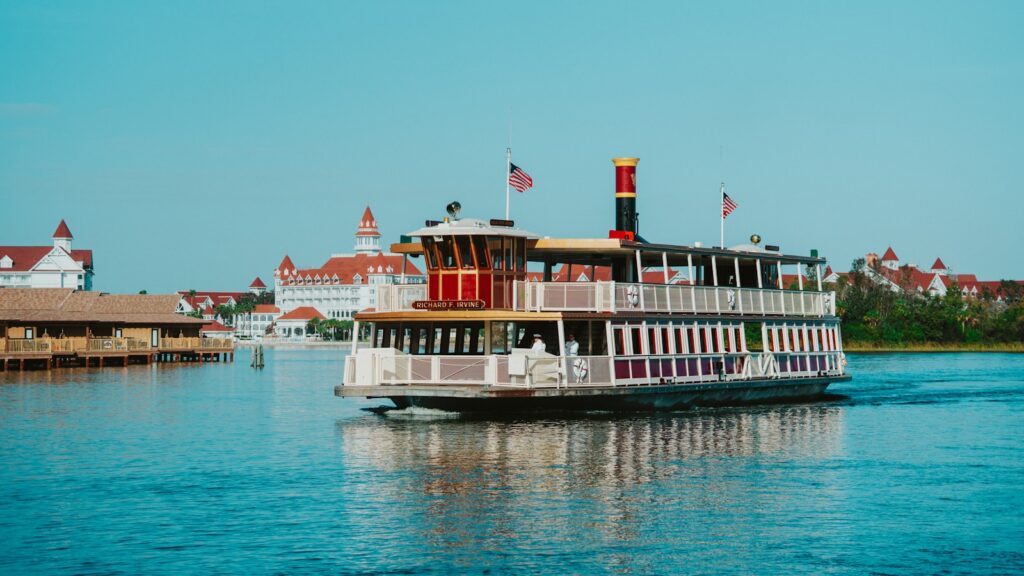
- TTC to Magic Kingdom ferry: high capacity, often quicker than the monorail at closing time
- Magic Kingdom to Wilderness Lodge, Fort Wilderness, Contemporary, and Grand Floridian: small launches, scenic, moderate speed
- EPCOT International Gateway to Hollywood Studios via the BoardWalk area: Friendship boats serving Yacht Club, Beach Club, BoardWalk Inn, and the Swan and Dolphin
- Sassagoula River Cruise: Port Orleans, Old Key West, and Saratoga Springs to Disney Springs (now subject to the June 2026 verification rule)

My rule: take the boat when the journey is part of the experience and you are not on a clock. Take it to a dinner reservation and you will spend the ride checking your watch. On the Friendship boats specifically, walking is usually faster than waiting, which brings me to the option everyone forgets.
Walking: the underrated system
Disney does not market walking as transportation, but in the EPCOT resort area it is the best option available.
- Contemporary → Magic Kingdom
- Grand Floridian → Magic Kingdom
- EPCOT International Gateway → Crescent Lake resorts
- EPCOT International Gateway → Hollywood Studios
- EPCOT-area resort → Hollywood Studios
Don’t automatically assume a motorized transportation system is faster than walking. At Disney World, waiting for a vehicle can take longer than simply walking the route.
Driving and parking: the numbers
Let’s say you decide to stay off-site and you have a car, here is what parking costs at the theme parks in 2026:
- Standard (car or motorcycle): $35 per day
- Preferred: $50 to $60 per day depending on season
- Oversized (RV, camper, bus, trailer): $40 per day
Standard theme park parking is included for guests staying at Disney resort hotels and for select Annual Passholders, and those guests can upgrade to preferred by paying only the difference, currently $15 to $25. Overnight self-parking at Disney resort hotels is free. Disney Springs parking is free. Water park and ESPN Wide World of Sports parking is generally free.
When Driving Makes Sense
- Staying off-site
- Visiting Universal/other Orlando attractions
- Large groups
- Animal Kingdom
- Carrying significant gear
- Grocery runs
- People who strongly prefer schedule control
When Driving Usually Doesn’t
- Magic Kingdom
- Monorail resorts
- EPCOT-area resorts
- Skyliner resorts
Important Note on Magic Kingdom. You park at the TTC and then still have to take the monorail or ferry to the gate, which turns a “quick drive” into a 30 minute arrival process. For Magic Kingdom days I would rather use Disney transportation and skip the two-step.
One practical note. Use Google Maps to get around property, but watch the overhead signs. Disney’s road network has service routes and Cast Member areas that navigation apps will happily send you toward. If you follow Disney’s purple and blue signs you will not accidentally leave the resort. I’ve personally experienced this when Google Maps took me into a Cast Members Only service area behind Magic Kingdom.
Uber, Lyft, and Minnie Vans
Rideshare works everywhere on property. A typical on-property Uber or Lyft runs roughly $15 to $20. Compare that to 45 minutes of bus transfers to get from Animal Kingdom Lodge to the BoardWalk. But is the cost worth it?
Minnie Vans are Disney’s own service, booked through the Lyft app, driven by Cast Members in polka-dotted Chevy Suburbans and Traverses. They now use distance-based pricing rather than the old flat rate, and typical on-property trips land between $40 and $70. That is often three times the cost of a standard Lyft and roughly double a Lyft XL, which is the fairer comparison since both seat six.
Is the premium worth it? Two situations where I say yes:
- Magic Kingdom drop-off. Minnie Vans are the only vehicles besides buses permitted to drop at the Magic Kingdom bus loop, right at the gate. Uber and Lyft drop you at the TTC, and then you are doing the monorail or ferry leg anyway
- Car seats. Each vehicle carries two, and Cast Members install them for you. Uber and Lyft car seat options at Disney run $40 to $60 anyway, which erases most of the gap
Otherwise, take the regular Lyft and put the difference toward dinner.
When Is Rideshare Worth It?
Take Disney transportation when:
- you’re flexible
- the route is direct
- you’re not racing a reservation
- the alternative requires only a short wait
Consider rideshare when:
- you’re making a resort-to-resort trip
- you have a hard dining reservation
- you’re exhausted after a long day
- you’re traveling during a transportation disruption
- you’re saving a substantial amount of time
Getting From Orlando International Airport to Disney World
Disney’s Magical Express is gone and has been since 2022. Nothing has replaced it as a free service. Your options:

- Mears Connect (Driven by Sunshine): the shared shuttle, run by the same company that operated Magical Express. Standard service starts around $16 to $18 per adult one way and $13 per child ages 3 to 9, with children under 3 free. It is a shared ride, so expect stops at other resorts. Express service is round trip only and starts around $250 for up to four passengers, putting your resort first off the airport and last before it
- Uber or Lyft: typically $35 to $60 one way depending on the resort and time of day, and dramatically faster than a shared shuttle. For a family of four this usually wins on both time and money
- Rental car: the right call if you are doing Universal, the coast, or serious grocery runs. Remember to price in resort and park parking
- Private car services: worth it if you want to know exactly who is picking you up. I have personally used “Uber Steve” and had a positive experience.
A family of four using Mears Connect round trip is looking at somewhere north of $110 before tips. Two Ubers, or one XL, will often beat that and save you an hour. Run the numbers before you default to the shuttle out of habit.
Getting to Disney World by Public Transportation
Orlando has a public bus system, and it does reach Walt Disney World. Almost nobody visiting uses it, and the reasons are worth understanding before you dismiss it or before you count on it.
LYNX operates the network. The routes that matter are Link 300, the Orlando/Disney Express, which runs between LYNX Central Station downtown and the Transportation and Ticket Center, and Link 56, which comes in along West US 192 from the Kissimmee corridor. Link 50 also serves the property. Fares are $2 for a single ride and $4.50 for an all-day pass, which is the cheapest way to reach Disney World that exists.
Here is the honest assessment. LYNX is built for the tens of thousands of Cast Members who commute to property every day, not for tourists hauling luggage. Service on the Disney routes runs roughly every 30 minutes, first buses leave before 5:30 in the morning and last runs are around 10 at night, which is earlier than fireworks let out. Trip times from downtown run 40 minutes or more before you have transferred to anything. Once you reach the TTC or the Disney Springs Transfer Center, you still have to get onto Disney’s own system to reach your actual destination.
Who this actually works for: budget travelers staying along US 192 in Kissimmee, solo visitors without luggage, and anyone staying downtown for reasons unrelated to Disney. Who it does not work for: families with strollers, anyone arriving from the airport with bags, and anyone leaving a park after a nighttime show. For that second group, a rideshare costs more and saves more than it costs.
Verify current routes and schedules with LYNX directly before you plan around them. Route structure and hours change, and the Disney-area routes are adjusted more often than the rest of the system.
Where You Stay Changes Everything
Disney World does not offer the same transportation options from every resort. Some resorts have walking access to a theme park. Others have the Skyliner, monorail or boats. Many rely primarily on buses.
Want to know exactly how transportation works from your resort? Use our Disney World Transportation by Resort tool.
How much time to budget
The number I use: 60 minutes from your room to a park turnstile. Not 30. Sixty.
That breaks down as time getting through your resort to the stop, wait time, ride time, and then security and bag check on the other end. If you are making rope drop or a hard reservation time, add 15 more minutes. If you are relying on a bus at a value resort during a busy week, add 30.
For dining reservations at another resort, budget 90 minutes if you are using Disney transportation. Or spend the $18 on a Lyft and reclaim your afternoon. One thing worth noting is that if a genuine delay occurred due to Disney’s transportation, most restaurants will honor your reservation when you finally get there. They do not HAVE to though, so don’t rely on it. A “genuine delay” means that the option you were taking broke down. Not that you arrived late.
Five Disney Transportation Mistakes
- Choosing a resort without considering transportation
- Planning from vehicle travel time instead of door-to-door time
- Assuming every resort has a bus to every park
- Treating Disney transportation as the only option
- Failing to have a backup plan when using weather-sensitive transportation
What changed in 2026
If you read a Disney World transportation guide written before this summer, it is already out of date in one specific way.
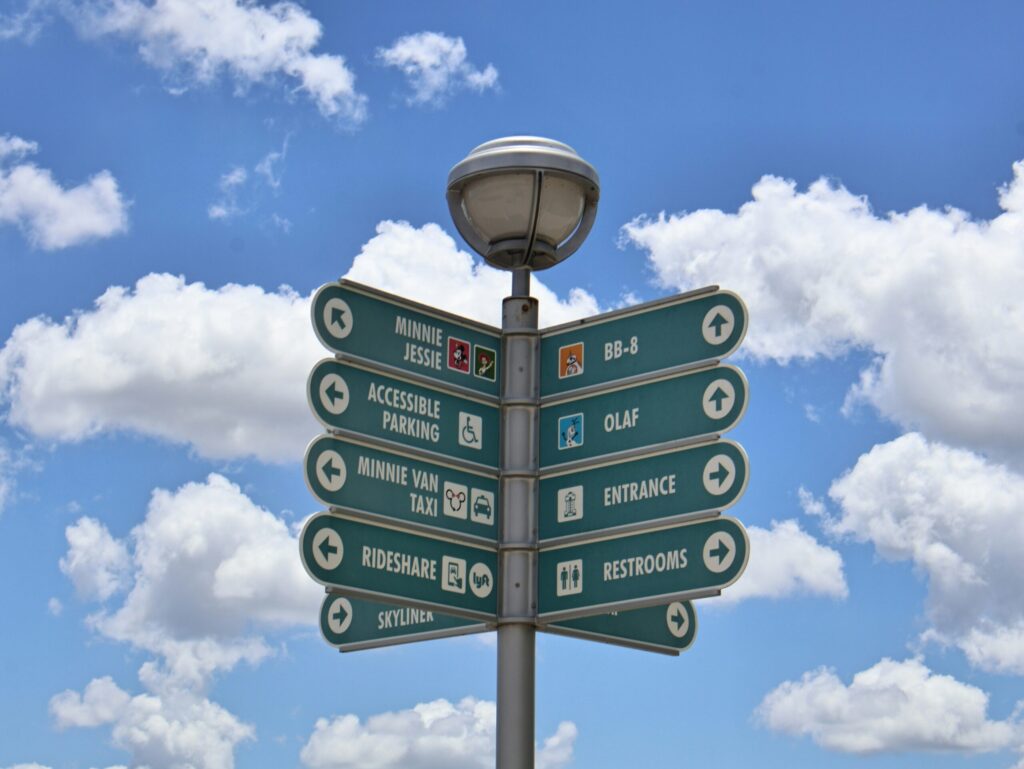
As of June 28, 2026, you can no longer board a resort bus or the Sassagoula River Cruise boats at Disney Springs unless you can prove you belong on them. Cast Members are stationed at the bus loops and the boat dock checking for a Disney resort room key, an active resort reservation, or a dining or experience reservation at a resort. If you have a dining reservation, you can board up to two hours before your reservation time.
Why this matters even if you never planned to do it: Disney Springs parking is free, and a lot of people had figured out they could park there, ride a bus to a resort, and then catch a second bus from that resort into a park. That loophole is closed. It also makes casual resort hopping meaningfully harder for day guests and off-site visitors.
In general, I think that Disney implemented this change to clamp down on guests parking for free at Disney Springs and then taking free Disney transportation to a resort within walking distance of the park they were going to that day.
The rest of the system is unaffected. Park buses, the monorail, the Skyliner, and theme park boats all still run for everyone.
Frequently asked questions about Disney World transportation
Is Disney World transportation free?
Yes. Buses, the monorail, the Skyliner, and boats are complimentary for all guests, whether or not you are staying on property. Since June 28, 2026, buses and boats leaving Disney Springs for resort hotels require a resort stay or a dining or experience reservation.
Do I need a car at Disney World?
No, and most guests do not. A car is worth it if you are visiting Universal or other Orlando attractions, doing grocery runs, staying off-site, or traveling with a group where rideshare costs multiply.
What is the fastest way between two theme parks?
Magic Kingdom to EPCOT: monorail via the TTC. EPCOT to Hollywood Studios: Skyliner or walk. Anything involving Animal Kingdom: drive or take a rideshare.
How early does Disney transportation start?
Buses generally begin about an hour before park opening. The Skyliner park lines typically start about an hour before opening, including Early Entry. The Resort and Express monorails start 30 minutes before Magic Kingdom opens.
Can I take the Skyliner to Magic Kingdom?
No. The Skyliner serves EPCOT and Hollywood Studios only.
Are Minnie Vans worth it?
Situationally. Yes for Magic Kingdom drop-off at the gate and for families needing car seats. Otherwise a standard Lyft does the same job for a third of the price.
The short version
Transportation shouldn’t be treated as the dead time between the things you actually want to do at Disney World. It is one of the variables that determines how much of your day you actually have available.
The best transportation choice isn’t always the fastest vehicle. Sometimes it’s walking. Sometimes it’s a Skyliner. Sometimes it’s a bus because it’s free and you’re in no hurry. And sometimes spending $20 on a rideshare is the best decision you can make.
Plan the transportation around what you’re trying to accomplish—not the other way around.
Magical Blueprint is an independent fan and travel-planning resource and is not affiliated with, endorsed by, or sponsored by The Walt Disney Company. Disney, Walt Disney World Resort, Magic Kingdom, EPCOT, Disney’s Hollywood Studios, Disney’s Animal Kingdom, Disney Skyliner, Minnie Van, and all related names, characters, and logos are trademarks of The Walt Disney Company and its affiliates. All prices, policies, and operating details are subject to change. Please confirm current information at disneyworld.disney.go.com before your trip.