You’re Not Saving Money by Skipping Lightning Lane — You’re Just Paying More Per Ride
Let me guess. You are planning your Magic Kingdom day, you have already spent approximately one million dollars on tickets, hotel, flights, and Mickey-shaped everything, and then you open the My Disney Experience app and see it: Lightning Lane Multi Pass. $32 per person.
And you think: nope. Hard pass. We will wait in line like we did during the Clinton administration.
I get it. On paper, skipping Lightning Lane looks like a smart financial decision. You are already bleeding money. Why add another charge?
Here is the part that only becomes obvious after your trip is over. Skipping Lightning Lane does not save you money. It hides where you are losing it.
One thing before we dig in. I am using Magic Kingdom as the case study for this whole post, because it is the park where the skip-the-line decision carries the most weight. All four parks have Lightning Lane, and the smart move is different at each one. Epcot, Hollywood Studios, and Animal Kingdom each have their own ride lineups, price ranges, and rope-drop math, and I will break those down in future posts. The dollars-per-experience thinking here applies everywhere. The specific numbers below are Magic Kingdom’s.
Let me show you exactly what I mean. But first, let us make sure we are speaking the same language, because Disney’s Lightning Lane system has a few layers and has gone through several name changes, and it trips people up.
Table of Contents
Lightning Lane 101: There Are Actually Two Different Things
Disney’s skip-the-line system is not one product. It is two, and confusing them will mess up both your planning and your budget math.
Lightning Lane Multi Pass (LLMP). This is the main product. One price per person per day (at Magic Kingdom, typically $29 to $45 depending on when you visit), and it covers most of the popular rides in the park. Space Mountain, Big Thunder Mountain Railroad, Tiana’s Bayou Adventure, Haunted Mansion, Peter Pan’s Flight, Buzz Lightyear, and Jungle Cruise are all in. You book up to three return windows in advance, then rebook one at a time as you use them, and you walk into a much shorter queue.
Lightning Lane Single Pass (LLSP). This is the a la carte option for the two rides too popular to be included in Multi Pass. At Magic Kingdom, those are TRON Lightcycle/Run (typically $19 to $23 per person) and Seven Dwarfs Mine Train (typically $11 to $15 per person). You buy these separately, up to two per day, and they have nothing to do with your Multi Pass purchase.
So if you want to Lightning Lane your way onto TRON, Mine Train, and everything else, you are potentially buying three things: LLMP, plus TRON Single Pass, plus Mine Train Single Pass. That is the full picture, and it is important context for the math we are about to do.
Here is the good news. You do not need all three. The smart move on TRON and Mine Train is a different strategy entirely, and it costs nothing.
Which Rides Are Even Worth a Lightning Lane? Start With the Component Method
Before you spend a dollar, understand this: a Lightning Lane is a finite resource. You get three advance bookings, then you rebook one at a time as the day goes. Every window you spend on the wrong ride is a window you did not spend on the right one. So the real question is not “should I buy Lightning Lane,” it is “which rides is it worth using on.”
That is exactly what the Component Method answers. It sorts every Magic Kingdom attraction into one of four load types, and only two of them are worth a Lightning Lane.
E-Ticket rides. Space Mountain, Big Thunder Mountain Railroad, Tiana’s Bayou Adventure, and the two Single Pass headliners, TRON and Seven Dwarfs Mine Train. High demand, high draw. Waits climb past 45 to 60 minutes by late morning and hold there until the evening. These are Lightning Lane’s bread and butter. Rope drop the one or two you can reach early, Lightning Lane the rest.
Perpetual Queue rides. Peter Pan’s Flight is the textbook case. Low hourly capacity plus steady all-day demand means the wait basically never drops. Not at rope drop, not at close. Peter Pan’s sits at 40 to 70 minutes from open to close, and there is no clever standby window that fixes it. This is where a Lightning Lane earns the most, because the alternative is not a shorter wait later, it is the same wait all day. Jungle Cruise leans this way too, since its boat capacity caps throughput.
High Capacity rides. Haunted Mansion, Pirates of the Caribbean, “it’s a small world,” and Buzz Lightyear. These load enormous numbers per hour, so standby self-corrects. Waits spike midday and fall back in the evening. Spending a Lightning Lane here usually burns a window you needed for an E-Ticket. Ride them standby while the E-Tickets are slammed, or after dinner when the park thins.
Low Demand rides. The PeopleMover, Carousel of Progress, Country Bears, Tom Sawyer Island. Near walk-ons most of the day, and several do not even have a Lightning Lane. Never a consideration.
Here is the whole strategy in one line. Skipping Lightning Lane is a question you answer per ride, not per day. Load your Lightning Lane budget onto the E-Tickets you cannot rope drop and the one Perpetual Queue ride that never lets up. Let the High Capacity rides soak up your standby time. Do that, and the pass pays for itself before lunch. The rest of this post is the math that proves it.
The Setup
Let us build a realistic scenario. You are a family of four visiting Magic Kingdom on a typical moderate-crowd day. Not Christmas, not Spring Break, just a regular Tuesday in March. You bought your tickets ahead of time at around $159 per person. Four tickets equals $636 out of pocket before you have eaten a single Dole Whip.
That is your investment. That is what you paid to walk through those gates.
Here is the question worth asking: what did you actually get for that $636?
The answer is not “a day at Magic Kingdom.” The answer is time, specifically the park’s operating hours. A solid 12-hour day, 9am to 9pm. That is what your $636 bought. What you do with those hours determines whether that $636 was a great investment or a very expensive walk around a theme park. (If you are still deciding how many park days to buy in the first place, our How Many Days at Disney World tool helps you size the trip before you get to this math.)
The No Lightning Lane Day
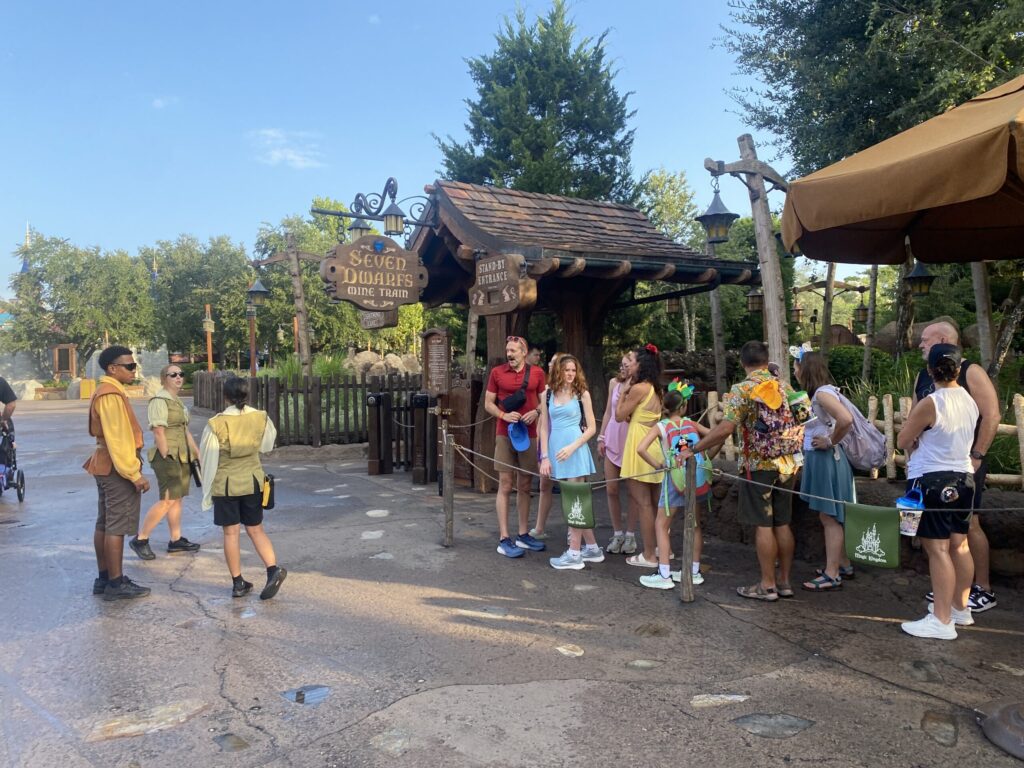
Here is what a no-Lightning-Lane day actually looks like at Magic Kingdom in March on a moderate crowd day.
TRON, Seven Dwarfs Mine Train, Space Mountain, Tiana’s Bayou Adventure, Big Thunder Mountain Railroad, and Peter Pan’s Flight are going to run 45 to 75 minute standby waits during peak daytime hours. That is not a guess. That is what the data shows, consistently, once 10:30am hits and the park fills up.
Let us be generous. You are a smart planner. You hit the park right at rope drop and beeline for TRON, then Mine Train while waits are still short. Here is what the rest of your day looks like:
| Time | Activity |
|---|---|
| 9:00am | Rope drop, TRON (20 min wait, not bad) |
| 9:35am | Seven Dwarfs Mine Train (30 min wait, still manageable) |
| 10:30am | Breakfast / walk to next land |
| 11:15am | Tiana’s Bayou Adventure (55 min standby) |
| 12:30pm | Lunch |
| 1:45pm | Space Mountain (65 min standby) |
| 3:05pm | Big Thunder Mountain (50 min standby) |
| 4:15pm | Haunted Mansion (40 min standby) |
| 5:00pm | Snack / parade / shopping / regroup |
| 6:00pm | Peter Pan’s Flight (60 min standby) |
| 7:15pm | Dinner |
| 9:00pm | Park closes |
Notice Peter Pan’s at 6pm, still a 60 minute wait. That is the Perpetual Queue in action. Twelve hours in the park and there was never a window where that line got short, because there never is one.
Count the headliner rides: 7 attractions on a solid day where you did everything right. Rope drop, smart routing, pushed through without much of a break.
Seven rides. Twelve hours. $636 for the family.
That is $90.86 per ride experience for your family, or roughly $22.71 per person per ride.
And you spent about 5 hours of your 12-hour day standing in standby lines. Five hours. At the most magical place on earth.
The Lightning Lane Multi Pass Day
Same family. Same day. Same park. You buy Lightning Lane Multi Pass at $32 per person, which is $128 for the family of four.
Here is the key. You are still rope-dropping TRON and Seven Dwarfs Mine Train in standby, same as the no-LL family. Those two are Single Pass only, and both are E-Tickets you can beat by arriving early rather than adding another $60 to $150 to the bill. More on that in a minute.
The difference is how you spend the pass. Following the Component Method, your Lightning Lane windows go on the E-Tickets you could not rope drop (Space Mountain, Tiana’s, Big Thunder) and the one Perpetual Queue ride that never lets up (Peter Pan’s). The High Capacity rides (Haunted Mansion, Pirates, Jungle Cruise, Buzz) go on standby in the midday and evening slots, where their waits self-correct.
You are saving 35 to 55 minutes per ride on exactly the rides where that time is unrecoverable. Across a full day, that adds up to something wild.
Here is the same day reimagined:
| Time | Activity |
|---|---|
| 9:00am | Rope drop, TRON (20 min wait, same as before) |
| 9:35am | Seven Dwarfs Mine Train (30 min wait, same as before) |
| 10:20am | Peter Pan’s Flight (Lightning Lane, 10 min) |
| 10:40am | Buzz Lightyear (standby, 15 min, still short midmorning) |
| 11:15am | Tiana’s Bayou Adventure (Lightning Lane, 10 min) |
| 11:45am | Jungle Cruise (standby, 25 min) |
| 12:30pm | Lunch, actual sit-down, you have time |
| 1:30pm | Big Thunder Mountain (Lightning Lane, 10 min) |
| 2:00pm | Space Mountain (Lightning Lane, 8 min) |
| 2:45pm | Haunted Mansion (standby, 20 min) |
| 3:30pm | Snack / parade / shows |
| 5:00pm | Pirates of the Caribbean (standby, 15 min) |
| 6:30pm | Dinner, relaxed, not rushed |
| 8:00pm | Second lap on a favorite, or an evening walk-on |
| 9:00pm | Happily Ever After fireworks |
Count the rides: 10 attractions, a real sit-down lunch, the evening fireworks, and you were not sprinting between lands all day. Notice the pass never touched a High Capacity ride. Those you handled standby, exactly where the Component Method says they belong.
Let us call it a conservative 10 rides for the family.
That is $76.40 per ride experience for the family, or $19.10 per person per ride.
The Math That Changes Everything
Here is the side-by-side I want you to sit with:
| No Lightning Lane | LLMP Only | |
|---|---|---|
| Ticket cost (family of 4) | $636 | $636 |
| Lightning Lane Multi Pass | $0 | $128 |
| Total spent | $636 | $764 |
| Rides completed | 7 | 10 |
| Cost per experience (family) | $90.86 | $76.40 |
| Hours in standby lines | ~5 hours | ~1.5 hours |
| Time freed up | — | ~3.5 hours |
You spent $128 more and got 3 more rides, a real lunch, the fireworks, and 3.5 hours back.
The family that skipped Lightning Lane paid $90.86 per ride experience. The family that bought it paid $76.40.
The family that “saved money” paid more per experience. They just did not see it on a receipt.
Want to run this against your own dates and party size instead of my example? Our Lightning Lane Cost Calculator does the per-ride math for you in about thirty seconds.
But What About TRON and Mine Train?
Fair question. Those are the two rides Multi Pass does not cover, and they are two of the most popular in the park. Both are E-Tickets, which by the Component Method means they are beatable at rope drop. You basically have three options.
Option 1: Rope drop them. This is what both families did above. Show up at park open, head straight for TRON, then Mine Train. Before the crowd machine kicks into gear, you are looking at 15 to 30 minute waits instead of 70-plus. You get both rides, you have not spent a dime extra, and your LLMP handles everything else. Smart, efficient, free.
Option 2: Buy Single Pass for one or both. If you are visiting on a heavy-crowd day, or your group has little ones who cannot maintain a rope-drop pace, Single Pass is worth a look. TRON Single Pass runs about $19 to $23 per person and Mine Train runs about $11 to $15 per person. For a family of four, that is $60 to $92 extra on top of your LLMP.
Add that in and your total is around $220 to $256 for the family, but you have now Lightning Lane’d essentially every major ride in the park. Your cost per experience drops further and your day is stress-free.
Option 3: Buy Lightning Lane Premier Pass. This is the money-is-no-object option. One pass covers every Lightning Lane in the park at your leisure, no booking windows, no strategy required. At Magic Kingdom, Premier Pass runs around $330 to $450 per person on peak days. That is a different conversation and a different type of traveler.
For most families, Option 1, or a combination of Option 1 and one Single Pass purchase, is the sweet spot.
“But We’re Good at Rope Dropping”
This is the classic counter-argument, and I respect it. Rope drop is real and it works.
But you cannot rope drop your way through an entire Magic Kingdom day. Once 10:30am hits and the park fills up, you are at the mercy of the standby queue. No touring plan and no crowd calendar changes the fact that Magic Kingdom is one of the most visited theme parks on Earth and roughly everyone on the planet decided to go the same day as you.
Rope drop buys you 2 to 3 early wins on E-Tickets. Lightning Lane buys you a whole different afternoon. They solve different halves of the day. (Rope drop works even harder if you are staying on-site and can use Early Theme Park Entry. Our Magic Kingdom Early Entry Strategy breaks down how to stack that window.)
Is Skipping Lightning Lane Ever the Right Call?
Yes, sometimes. Skipping Lightning Lane can be correct on a genuinely low-crowd day, at a park where standby waits stay reasonable all afternoon (Animal Kingdom and off-peak Epcot are the usual candidates), or when your group is happy doing fewer rides at a slower pace.
There is one more case: if you have a strong command of the Component Method, you can sometimes skip Lightning Lane at Magic Kingdom by routing your entire day around it. You rope drop the E-Tickets, hit the High Capacity rides during the midday crush when they still move, and accept that Peter Pan’s is a one-and-done wait. That works. It also requires precision and a party that can keep pace. For most families, Lightning Lane is the tool that executes the Component Method without demanding perfect discipline.
What makes it the wrong call is skipping Lightning Lane at Magic Kingdom on a moderate-to-busy day and assuming you saved money. That is the specific trap this whole post is built around. The dollars stay in your pocket, but the value leaks out of your day in 45-minute increments. The way to know for sure is to run your real dates, which is what the calculator above is for.
The Real Hidden Cost of Skipping Lightning Lane
Here is what I want you to think about as you finalize your trip budget.
You probably did not book the cheapest hotel. You are probably not eating fast food for every meal. You have invested real money and real vacation days into this trip. For most families, Disney World happens once every few years, sometimes less. (The Lightning Lane line is one of many that quietly adds up, which is the whole reason we keep a running breakdown of the hidden costs of a Disney World trip.)
The hidden cost of skipping Lightning Lane is not just the extra rides you missed. It is the trip you could have had versus the one where five of your twelve hours were spent shuffling forward in a standby queue, kids getting antsy, adults getting hangry, everyone staring at a posted wait time and doing very sad math in their head.
At $32 per person, Lightning Lane Multi Pass is the highest-return purchase left on the table after your park ticket. Not a luxury. Not a splurge. The thing that makes the investment you already made actually pay off.
Quick Reference: What You’re Working With
Here is a cheat sheet on current pricing so you know what to plug into your own math:
| Product | Typical Price | What It Covers |
|---|---|---|
| LLMP, Magic Kingdom | $29 to $45 / person / day | Most popular rides (Space Mountain, Tiana’s, Big Thunder, Haunted Mansion, Peter Pan’s, and more) |
| LLSP, TRON Lightcycle/Run | $19 to $23 / person | TRON only |
| LLSP, Seven Dwarfs Mine Train | $11 to $15 / person | Mine Train only |
| Premier Pass, Magic Kingdom | $330 to $450 / person | Every Lightning Lane in the park, one ride each, no windows |
Prices vary by date and crowd level. Peak days (Spring Break, holidays, summer weekends) push toward the high end, and Single Pass can sell out. Off-peak weekdays in January, May, or September are when you will find the best pricing. Resort guests can book Multi Pass 7 days ahead at 7am; off-site guests, 3 days ahead.
The Bottom Line: Skipping Lightning Lane
Skipping Lightning Lane feels like saving money. It is not.
When you do the math with real ticket prices, real wait times, and real rides per day, the family that bought Lightning Lane Multi Pass paid less per experience than the family that did not. They also got more rides, more breathing room, and more of the trip they actually paid for. The pass only works that hard, though, when you spend it the way the Component Method tells you to: on the E-Tickets and the Perpetual Queue, not the rides that fix themselves.
There is a smarter way to think about every dollar you spend at Disney World. Not “how much did this cost,” but “what did I actually get for it.” That way of thinking changes everything about how you plan a Disney trip, and we are just getting started here at Magical Blueprint.
If you have little kids, using Lightning Lane can also cut down on meltdowns by reducing the time standing in boring lines. Check out our post on avoiding Disney World meltdowns.
Frequently Asked Questions
Is skipping Lightning Lane worth it at Magic Kingdom?
On a moderate-to-busy day, no. When you divide your ticket cost by the rides you actually complete, skipping Lightning Lane usually costs you more per experience than buying it, because standby waits eat hours you already paid for. On a genuinely quiet day it can be the right call. Run your real dates to be sure.
How much does Lightning Lane Multi Pass cost at Magic Kingdom in 2026?
Magic Kingdom Multi Pass typically runs $29 to $45 per person, per day, priced dynamically by date and demand. Off-peak weekdays sit near the floor and holiday weeks push toward the ceiling. Prices are released up to 21 days out in the My Disney Experience app.
Do I need Lightning Lane Single Pass for TRON and Seven Dwarfs Mine Train?
Not necessarily. Both are Single Pass only and aren’t included in Multi Pass. For most families the cheaper move is to rope drop both at park open when waits are 15 to 30 minutes, then let Multi Pass handle the rest of the day. Buy Single Pass only on heavy-crowd days or when a rope-drop pace isn’t realistic.
Can I just rope drop instead of buying Lightning Lane?
Rope drop works for the first two or three rides of the day, but you can’t rope drop an entire Magic Kingdom day. Once the park fills around 10:30am, you’re stuck in standby. Rope drop and Lightning Lane solve different halves of the day.
What’s the difference between Multi Pass and Single Pass?
Multi Pass is one daily price covering most popular rides through booked return windows. Single Pass is bought per attraction for the two headliners left out of Multi Pass (TRON and Seven Dwarfs Mine Train at Magic Kingdom). Premier Pass is a separate premium option covering everything at once.
A few honest notes.
Magical Blueprint is an independent fan site. It is not affiliated with, endorsed by, or sponsored by The Walt Disney Company or its affiliates. Walt Disney World, Magic Kingdom, Lightning Lane, TRON Lightcycle/Run, Seven Dwarfs Mine Train, and all related names, logos, and attractions are trademarks of their respective owners, used here for identification and commentary only.
This article is for general informational purposes and reflects my own opinions and experience. It is not financial advice. Lightning Lane is a dynamically priced product, and pricing, park hours, ride availability, and Disney policies change constantly. Verify current prices in the My Disney Experience app before you buy.
The views here are my own. I received no compensation from Disney or any third party for this post.